Monday, July 25, 2011

Kanheri Caves_Mumbai


Heard about Kanheri Caves long back but get a chance to visit these marvels in June this year only.
These Buddhist Rock cut caves dates back to 1 BC and 9 AD.  Kanheri caves located in the deep forests famously known as Sanjay Gandhi National Park in Borivli in Mumbai. 


   These beautifully carved figures adorned at the entrance,     welcoming the tourists to this huge Buddhist habitat.


This huge Buddha was busy giving company to the Tourists
sitting on its feets for the photographs. 


This is the main prayer hall called Chaitnya in Buddhism. 
 It seems that the ceiling of this hall was adorned with something may be with wood as I had seen in Karla Caves.


Inscription on the pillar of Chaitnya Hall.  Is it Palli or some other script, I do not know and I do not know how these beautiful small words were carved on the rock.


Delapidated Buddha Statue.


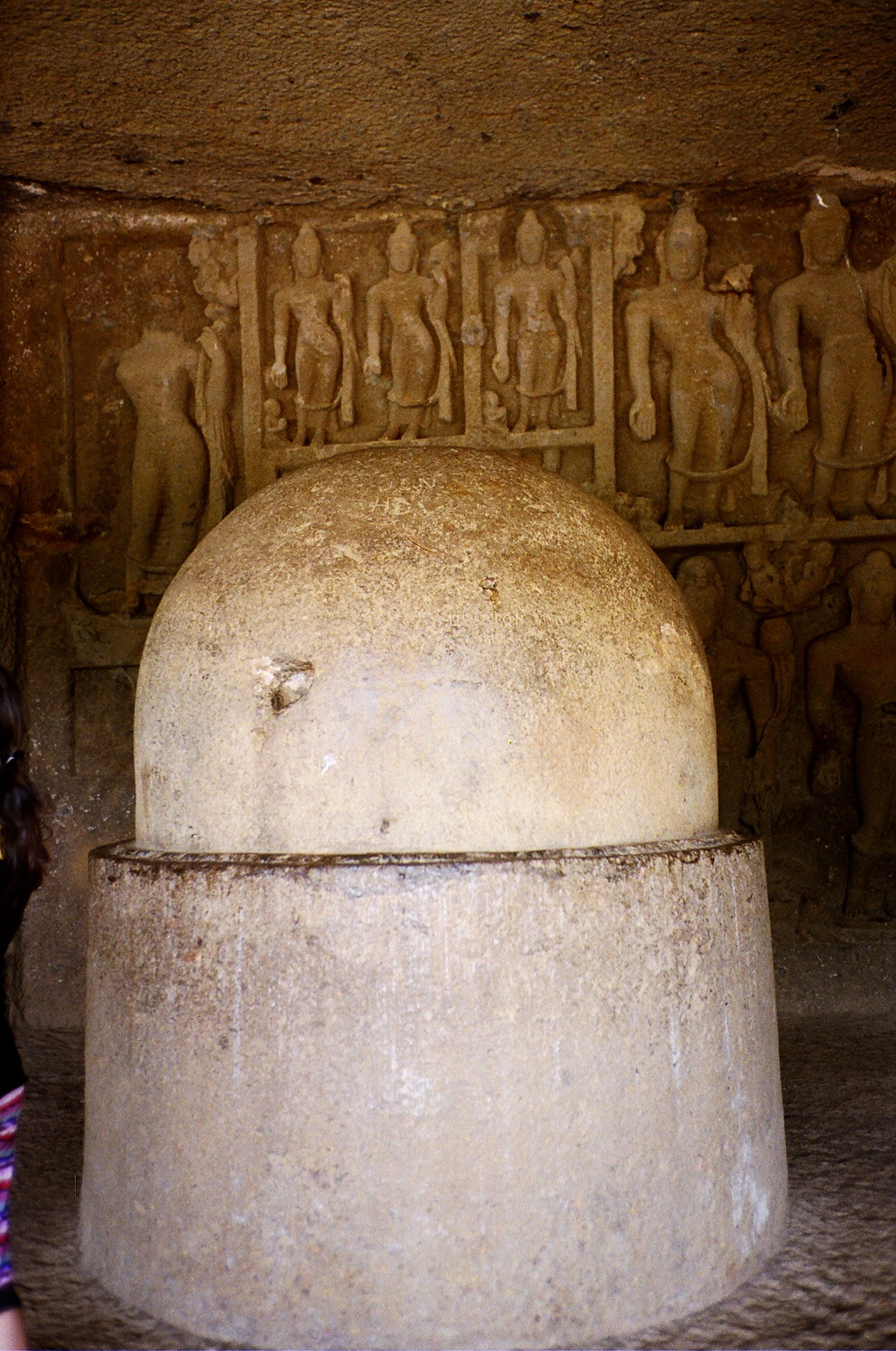
Stupas carved on the walls of the main cave.


Are the guards are for this Cobra or Sheshnaag in the middle of this carving.  Why these carvings do not speak and narrate their stories....may be they are telling something but I am not able to understand them.... 


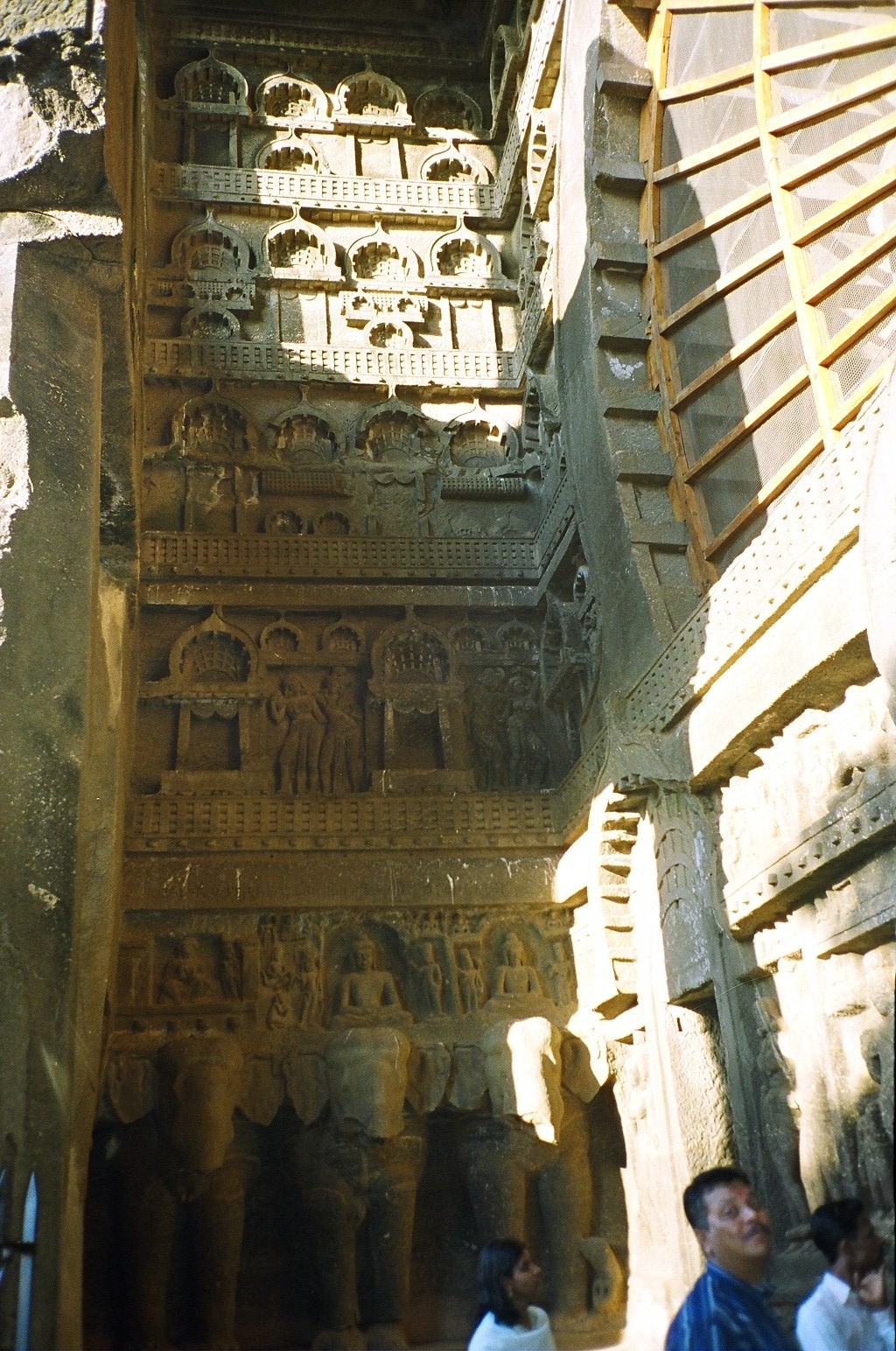
The main cave 

All these figures in Buddist caves have similarities in their
 dress their headgears. 
 Was Buddhism all over India? 
Then why and how it has almost vanished in India?


These caves are scattered on a very large area in this part of Mumbai. 
 It seems it was a huge habitat or a university.


I wonder how and in how many years they have carved these dormitories out of the hard rocks.


 Here people are enjoying in one of the reservoir or a canal.
These caves have a perfect water harvesting system. One can find many water channels and reservoirs to store the water. Same thing is found in Karla caves also. 
I have visited many historical places in our country,
and have found that people or the architects of that era were more aware of the water harvesting. 
 I have seen in Mandu a perfect system of water harvesting.


I have not covered all the caves, next time
I will go with lots of time and a very good camera.
The caves are surrounded with the real jungle and trek trails.
Once you are in this Sanjay Park, you forget that you are in Mumbai 
Why this park is named after Sanjay,
 it could have some refreshing name.

Yes, you rightly said it is difficult to imagine such a place in a city like Mumbai.


Friday, July 1, 2011

Mahabalipuram


Mahabalipuram, 60 kms. from Chennai the capital city of Tamil Nadu, the Southern Indian state is a bundle of wonders. Mahabalipuram a port city in 1st AD a place of complete awe, master creations show the patience of artisans. 
A complete rock carved into a depiction of incidents of Mahabharta.


Here Draunacharya, the Guru of Pandavas and Kauravas
 is seen sitting on the left side.


Complete view of the rock. 
Animals carved beautifully can be seen from a distance.


In the middle the Ganges is shown as a Cobra.


The two resting Deers carved below the Draunacharya,
found their place on the ten rupee note.


Here Arjuna is shown meditating.
After his penance he  was able to get the weapon from shiva. 
The peaceful atmosphere around is carved beautifully.


Sau chuhe kha kar billi Haj karne chali. 
 A cat surrounded by rats is shown meditating on her hind legs beneath the elephant's tusk.


A cave is also carved from the same mountain.
Among the front five pillars in front of the cave, the fourth pillar from left is not the original one. 
 I was told by the guide, this pillar was reconstructed by the Brits.  Good gesture.


I was informed by the guide that the faces on these pillars are of Chinese loins.
  I failed to understand how come the chinese lions reach there.  So the chinese invasion is so old ?


The rock cave supported by pillars.


There is a country called India, a bundle of wonders.

Thursday, June 9, 2011

Karla Caves-Rock cut Caves

 Karla Caves in Lonavala are rock cut Buddhist caves standing magnificently on Mumbai Pune highway


On way to Karla Caves, I do not know the name of these birds.


I dont know how  and why Godess Ekvira appeared in front of these caves.


The national emblem on the top of pillar (authentication)


The places related to Buddha bears the same design and pattern whether it is Sanchi, Ajanta Caves, Bhaje caves or Karla Caves.  This pattern is missing in Leh.


Carved figures adorn the entrance of caves. 
Here again it bears the same pattern of dress an headgears which is found in Era of Buddha or Ashoka.


Imaculatly carved figures


This Prayer Hall in the caves is the master pieces of  architecture.  This prayer hall is considered to be the largest in the country and  well preserved.


The wooden planks in the ceilings date back to 2500 years. 
It is the most astounding feature of caves and one wonders about the life of wood. 
No traces of ageing is found.....indeed wonderful


The ceiling of the cave is supported by these strong pillars.


These small cubicles are the vihars on the first floor of the caves. 


On entry of these cave one can find a Ekvira Temple. 
The place is thronged by locals for the reason of this temple only. 

Our country was so rich technically in that era,
it gives a feeling of pride. 
 How they have created such master pieces is really wonder ful.

Are we able to create such wonders in today's times.

Friday, June 3, 2011

Thiksey Monastry in Leh


Thiksey Monstry in Leh


A beautiful Monastry in Leh in the style of Tibetan Style rather it is Tibetan Monastry. 


This monastry is a 12 storey complex and is built on a hill.


This is the interior of  prayer Hall beautifuly decorated.


The kids in the monastry responded emphatically - No photo- when I tried to take the picture of one of the bubbly kids.  They had a school beneath the prayer hall. 


This is a view of Thiksey village from the Monastry.


This is a door to the library. An instruction written on the left side of the door
-PLEASE TAKE OUT YOUR SHOES MY DEAR FRIEND-


There must be a fixed time for the library, but I had no patience. 
 I found one of the windows open, so I sneaked my camera and took the pictures of the interiors of the library. 
Old books related to Buddhism are stacked here
 wrapped in bright colours.


Buddha as well as Buddhism always facinated me.  Before leaving for Leh, I had this thought of converting to Buddhism. But after visiting these monastries, I reverted back.  I do not understand why these monastries are so depressingly dark.  Buddha and Buddhism were born here but I did not find the traces of Indian Buddhims or Buddha in this part of India.  I could not understand this way of worshipping in darkness. 

Otherwise, I found Leh very beautiful. 
It is full of colours but I found the life dull.